


Endgame vs Chess: What’s the Difference?
One of the great starting points and constant sources of inspiration for the creation of Endgame has been the fabulous game of chess.
However, but the two strategy board games differ in important ways. Both use an 8 × 8 board and 16 pieces per player. Endgame introduces military vehicles, weapons, prisoner-of-war camps, a Grey Market and happenstance events.
Unlike chess, Endgame includes elements of luck and initially imperfect information. The comparison below explores how the games differ in their pieces, movement, combat, game modes and underlying mechanics.
Some of the main differences are:
| Feature | Chess | Endgame |
|---|---|---|
| Game board | 8 x 8 | 8 x 8 plus additional areas |
| Pieces per player | 16 | 16 vehicle pieces |
| Weapons | ─ | 14 in total |
| Turn structure | Move a piece | Move a vehicle, then a weapon piece |
| Luck | No random events | Happenstance events |
| Information | Perfect | Initially imperfect |
| Captured pieces | Removed from play | Sent to POW camps |
The most relevant and noteworthy differences between chess and Endgame are summed up in the tables below.
Game artifacts
While chess is played with 32 pieces on a conventional 8 × 8 board, Endgame expands the battlefield with prisoner-of-war camps and a Grey Market. Its additional weapon and happenstance pieces introduce new dimensions to the game beyond the movement of vehicles.
| Game artifact | Chess | Endgame |
|---|---|---|
| Game board | Board with 8 x 8 squares (□) | Battlefield with 8 x 8 squares (□), 2 x POW Camps, and 1 x Grey Market |
| (Vehicle) pieces | 2 x 16 pieces, in total 32 pieces | 2 x 16 vehicle pieces, in total 32 pieces |
| War pieces | ─ | 14 x weapon pieces |
| Happenstance pieces | ─ | 6 x happenstance pieces |
| Game bag | ─ | 1 x Grey Market bag |
Game modes
Chess and Endgame both offer a standard game mode, but Endgame also introduces options involving weapons of mass destruction and innovation. In the innovation mode, certain pieces may acquire additional capabilities as the game progresses, potentially changing the strategic possibilities during play.
| Game mode | Chess | Endgame |
|---|---|---|
| Standard | Yes | Yes |
| Including WMD | ─ | Yes |
| Including innovation (dynamic pieces) | ─ | Yes |
Vehicle & War pieces: Directions of movement
Chess pieces have distinct movement patterns, including horizontal, vertical, diagonal and knight-specific moves. In Endgame, vehicles generally move along horizontal and vertical lines, while mortars, drones and missiles operate diagonally. This separation between vehicle movement and weapon direction creates a different tactical structure.
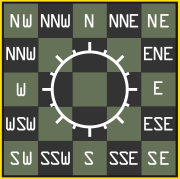
| Chess | Directions | Endgame | Directions |
|---|---|---|---|
| Pawn | N (and NE and NW en passant) | Armoured Car | N, E, S, W |
| Bishop | NW, NE, SW, SE | Tank | N, E, S, W |
| Knight | NNE, ENE, ESE, SSE, SSW, WSW, WNW, NNW | Truck | N, E, S, W |
| Rook | N, E, S, W | Warehouse | N, E, S, W |
| Queen | W, NW, N, NE, S, SW, SE, E | General & Doppelgänger | N, E, S, W |
| King | W, NW, N, NE, S, SW, SE, E | Minefield | ─ |
| ─ | ─ | Mortar | NW, NE, SW, SE |
| ─ | ─ | Drone | NW, NE, SW, SE |
| ─ | ─ | Missile | NW, NE, SW, SE |
Note that when playing the “innovation game mode”, some Endgame pieces may get additional capabilities over the course of a game.
Vehicle & War pieces: Moving and impact range
It is seen that some of the chess pieces have a much longer range than the equivalent Endgame pieces, making rapid attacks over the full chess board possible. However, a vehicle piece in combination with a missile can have a significant range of impact as well (see e.g. the example on the Tactics page).
Where the Pawn in chess can move up to 2 in its first move and then only 1 forward (or √2 in en passant) and never backwards or to the side, Endgame does not include any such restrictions.
| Chess | Moving & impact range (min-max in square lenghts) | Endgame | Moving range (min-max in square lengths) | Impact range (min-max in square lengths) |
|---|---|---|---|---|
| Pawn | 1 – 2 | Armoured Car | 1 | 1 |
| Bishop | √2 – 7√2 | Tank | 2 | 2 |
| Knight | √5 – √5 | Truck | 3 | 3 |
| Rook | 1 – 7 | Warehouse | 1 | 1 |
| Queen | 1 – 7√2 | General & Doppelgänger | 2 | 2 |
| King | 1 – √2 | Minefield | 0 | 1 – √2 |
| ─ | ─ | Mortar | ─ | √2 – √2 |
| ─ | ─ | Drone | ─ | √2 – 2√2 |
| ─ | ─ | Missile | ─ | √2 – 3√2 |
Vehicle & War pieces: Airborne capabilities
In chess, the knight can jump over other pieces, and the king can do so together with a rook during castling. Endgame’s vehicle pieces have no airborne capabilities, but mortars, drones and missiles do. This makes the distinction between ground movement and airborne weapon capabilities particularly important.
| Chess | Ability to fly | Endgame | Ability to fly |
|---|---|---|---|
| Pawn | No | Armoured Car | No |
| Bishop | No | Tank | No |
| Knight | Yes | Truck | No |
| Rook | No | Warehouse | No |
| Queen | No | General & Doppelgänger | No |
| King | Yes (once, during castling) | Minefield | No |
| ─ | ─ | Mortar | Yes |
| ─ | ─ | Drone | Yes |
| ─ | ─ | Missile | Yes |
Game pieces: Happenstance pieces
Unlike chess, Endgame includes happenstance events that can unexpectedly affect the battlefield. These range from weapons failing or becoming unavailable to friendly fire, prisoner exchanges, escapes and additional captures. As a result, players must prepare for uncertainty rather than relying entirely on predictable outcomes.
| Happenstance | Chess | Endgame |
|---|---|---|
| Embargo | ─ | No new weapons |
| Dud | ─ | Return weapon |
| Friendly fire | ─ | Fire weapon on your own vehicle |
| POW Exchange | ─ | Exchange imprisoned vehicle pieces |
| POW Escape | ─ | Vehicle piece escapes |
| AWOL | ─ | Vehicle piece captured |
Game mechanics: The Move
A chess turn normally consists of moving a single piece, whereas an Endgame turn involves two steps: moving a vehicle and then moving a war piece. Endgame also replaces certain familiar chess mechanisms with its own, including doppelgängering.
This creates a different relationship between movement, combat and tactical planning.
| Mechanism | Chess | Endgame |
|---|---|---|
| The move | Single step: Move a piece | Two steps: Move a vehicle piece, then move a war piece |
| Move two pieces at once | Castling | Dobbelgängering |
| Move a piece in a specific way once | En passant | ─ |
| Move a piece in a specific way once | Move a pawn two squares | ─ |
| Replace a piece with another piece | Pawn promotion | ─ |
| No legal move | Stalemate | ─ |
| Declaration and obligation | “Chess” declared and obligation for opponent to move | Declaration of “imminent danger” not required and no obligation for opponent to move |
Game mechanics: Eliminating (vehicle) pieces
In chess, captured pieces are permanently removed from the game. In Endgame, eliminated vehicles are instead placed in prisoner-of-war camps, whether captured through vehicle collisions, weapon fire or minefields.
Because some happenstance events can return imprisoned vehicles to play, a capture does not necessarily mean a permanent loss.
| Mechanism | Chess | Endgame |
|---|---|---|
| A (vehicle) piece moving to a square occupied by the opponent´s piece | The opponent´s piece is captured and permanently removed from the board | Both vehicle pieces are placed in the appropriate POW Camps |
| A vehicle pieces fires a weapon at another vehicle piece | ─ | The vehicle piece that has been captured is placed in the appropriate POW Camp. |
| A vehicle piece enters the opponent’s Minefield | ─ | The vehicle that has entered the minefield is placed in the appropriate POW Camp |
The basics of the game
Chess is a game of perfect information without random events, while Endgame incorporates some luck and initially imperfect information. Endgame also offers alternative game setups and both basic and advanced scoring systems. These features introduce additional uncertainty and different ways of evaluating game outcomes.
| Feature | Chess | Endgame |
|---|---|---|
| Point system | One: Basic | Two: Basic and Advanced |
| Game setup | Standard | Standard |
| Semi-random game setup | Freestyle (Chess960) | Semi-random (semi-random mirrored permutation) |
| Random game setup | ─ | Random (random mirrored permutation) |
| Luck | No luck | Some luck |
| Information | Perfect | Not perfect (initially) |
| Zero-sum game | Yes | No |